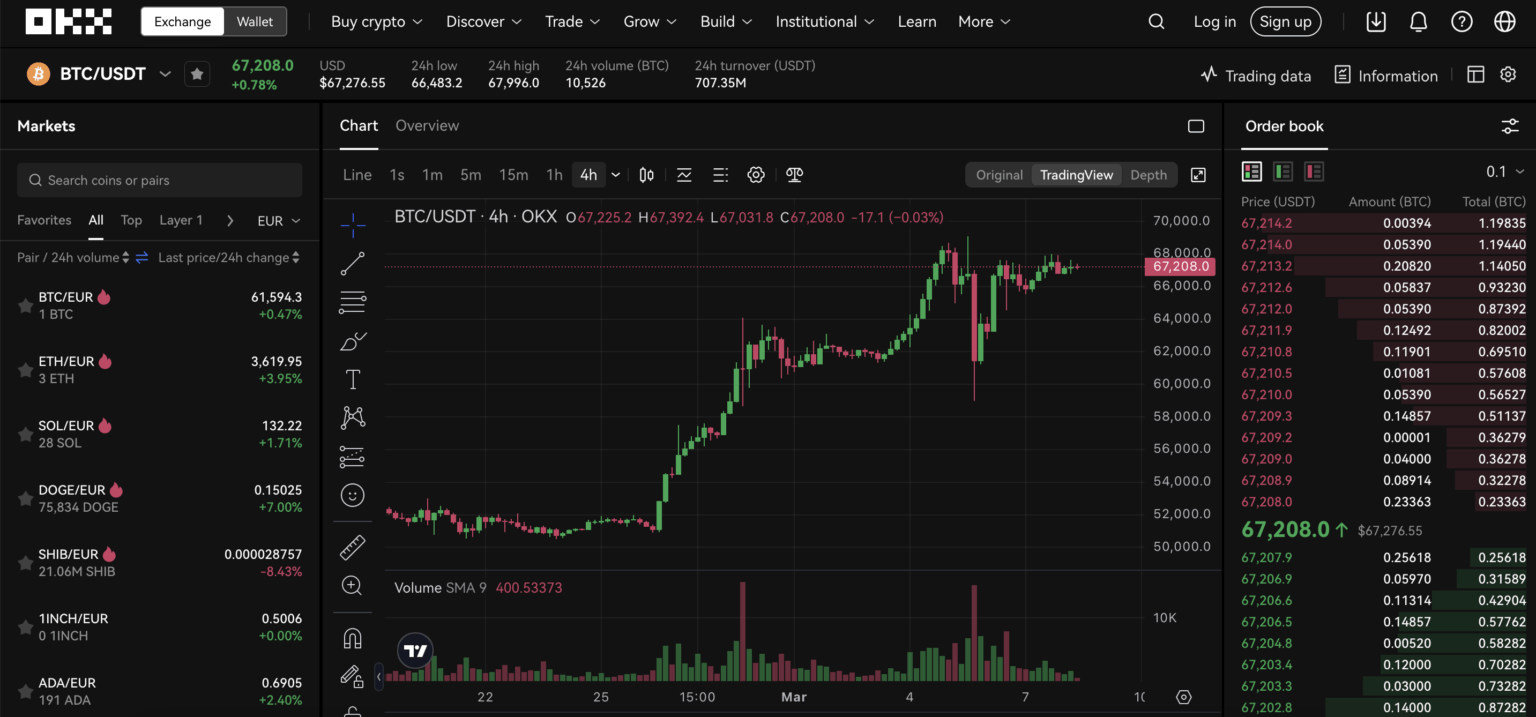
It’s 8:15 a.m. in New York and your price alerts have triggered: BTC is breaking a resistance level you’ve watched for days. You need to log into your OKX account, check spot liquidity, and decide whether to buy now or wait for a better fill. This moment—when authentication, exchange architecture, and market microstructure collide—determines whether a trade executes smoothly or becomes a costly lesson in slippage and risk.
This article unpacks two tightly linked questions for US-based crypto traders: (1) how OKX’s login and account-protection mechanisms work in practice, and (2) whether OKX’s spot trading environment is the right fit for your strategy. I’ll compare alternatives, explain internal mechanisms (what happens behind the scenes when you sign in and when you post a spot order), highlight trade-offs and limits, and finish with decision heuristics and what to watch next.
How OKX Login Works: Mechanisms, Multi-layer Defences, and Failure Modes
At a technical level, an OKX login is a short chain of layered checks: identity assertion (username/email), credential verification (password), device/session risk scoring (AI-driven anomaly detection), and a mandatory second factor (2FA). For US users, KYC is part of account lifecycle: ID verification and a liveness facial check are required for full access. These pieces are built to satisfy AML rules while also enabling features like fiat rails and higher withdrawal limits.
What does that mean for the trader in the example? When you enter credentials, OKX runs a risk assessment in real time. If the system flags an unusual IP, device fingerprint, or behavioral anomaly, it may force additional verification or temporarily block high-risk actions (like large withdrawals). Two important mechanisms reduce systemic risk: army-grade encryption for stored credentials and an AI-based detector that learns normal login patterns to spot outliers.
There are limits and trade-offs. Stronger friction (strict 2FA, frequent re-authentication) reduces account-takeover risk but raises cognitive and time costs—an obvious issue for active traders who must execute quickly. Biometric mobile logins solve much of that friction, but depend on your device’s security and carry privacy trade-offs. For users who prefer hardware wallets and full self-custody, OKX also supports a non-custodial Web3 wallet with seed phrases and hardware integrations—this separates trading identity from private key custody, but it introduces permanent-loss risk if seed phrases are lost.
Practical note: embed secure habits into the login flow. Use a password manager to avoid typing errors under stress, set Google Authenticator rather than SMS where possible (SMS is vulnerable to SIM-swap), and enable device whitelisting if you trade actively from a predictable set of terminals. If you want a quick route from browser to trade, the exchange supports biometric mobile logins and browser-extension interactions; for instructions and a safe entry point, use the official login guidance instead of ad-hoc bookmarks or suspect links—one convenient resource is the official okx sign in page linked below.
Spot Trading on OKX: Architecture, Liquidity, and the Real Costs
Spot trading is the simplest market mechanically—buy at the best available ask, sell at the best available bid. But “simple” hides two crucial mechanisms that determine outcomes: the order book microstructure and the liquidity aggregation layer. OKX supports more than 300 assets and provides advanced TradingView charting and order types via its web and mobile platforms. The exchange also aggregates liquidity across internal and some external venues, which reduces the chance of wide spreads for major assets but can still leave smaller tokens vulnerable to illiquidity.
Execution quality depends on three interacting factors. First, order book depth: deep books for BTC and ETH generally produce tight spreads and predictable slippage. Second, order type and routing: market orders deliver speed at the cost of potential slippage; limit orders lock price but may not fill. Third, cross-chain and aggregator mechanics: OKX’s DEX aggregator sources liquidity from Uniswap and others for swaps, which can produce better routes for certain token pairs, but cross-chain bridges add latency and smart-contract risk.
There are built-in trade-offs. Margin trading (up to 10x on spot margin) increases potential upside but also increases liquidation risk; derivatives products on OKX offer up to 125x leverage for some futures, which is a different risk profile entirely. For a US trader focused on spot trading, the sensible trade is often time-priority and depth-aware limit orders: use limit orders when the book is thin, use market or IOC only when speed outweighs price certainty. And always pre-flight-check: look at the order book depth for the size you want to trade, not just the top-of-book spread.
Security Architecture and Proof-of-Reserves: What They Do—and Don’t—Guarantee
OKX keeps over 95% of assets in offline, air-gapped cold wallets with multi-signature withdrawal controls. That lowers systemic custodial hack risk. The exchange also publishes Proof of Reserves (PoR), allowing on-chain verification that user deposits are backed 1:1. Mechanistically, PoR improves transparency because anyone can compare liabilities and on-chain assets. Yet PoR is not a substitute for operational resilience: it does not guarantee business continuity, counterparty solvency in extreme stress, or insurance against all theft vectors (internal fraud, social engineering, or complex protocol-level attacks).
For US traders, the practical implication is a hybrid posture: trust but verify. Use centralized custody for liquidity and convenience when trading spot at scale, but split exposure between exchange custody and self-custody for long-term holdings. If you rely heavily on OKX for spot activity, use 2FA and withdrawal whitelisting; for large, longer-term holdings consider hardware wallets integrated with OKX’s non-custodial wallet tools.
For more information, visit okx sign in.
Comparing OKX’s Spot Environment to Common Alternatives: Best-fit Scenarios
Here is a compact comparison of who should favor OKX for spot trading vs. alternatives (other major CEXs, DEXs, and self-custody workflows):
- Choose OKX if you need broad asset coverage (300+ coins, 130+ blockchains), advanced charting, and a single interface that also gives access to staking, NFTs, and derivatives. OKX’s cross-platform accessibility and DEX aggregator help traders who occasionally need on-chain swaps or cross-chain transfers without leaving the platform.
- Choose a DEX or self-custody if counterparty risk and regulatory exposure are your primary concerns. DEXs avoid account login friction and KYC but expose you to smart contract risk and on-chain gas costs; they’re better for one-off swaps and small trades rather than high-frequency or fiat-integrated strategies.
- Choose another regulated US-friendly exchange if local fiat rails, bank integrations, or specific listing policies matter. OKX’s recent strategic ties with major traditional finance actors may alter access or product mix, but regulatory clarity and US banking relationships remain the practical considerations for certain institutional flows.
Where OKX Breaks: Known Risks, Edge Cases, and Operational Limits
Be explicit about failure modes. During extreme volatility, even deep books experience slippage: market orders can execute across many price levels. Low-volume altcoins can have wide bid-ask spreads and shallow depth, making large spot fills expensive or partial. Cross-chain transfers routed by DEX aggregators introduce latency and smart contract dependence—each bridge hop is an additional point of failure. Finally, KYC and AML checks can slow account actions; if you intend to trade fast at scale, complete identity verification and any required limits well before a market event.
Another boundary condition: PoR and cold storage reduce custodial hacking risk, but they do not immunize users from phishing or credential theft. AI-based anomaly detection improves safety but can generate false positives that delay trades at critical moments. The trade-off is again between operational speed and security rigor.
Decision Heuristics: A Short Checklist for Logging and Trading Quickly but Safely
Use this rule-of-thumb when you must move fast:
- Pre-verify: complete KYC and withdrawal-whitelist steps before a market event.
- Secure device: enable biometric or app-based 2FA; prefer authenticator apps to SMS.
- Evaluate depth: glance beyond top-of-book; match order size to visible liquidity.
- Choose order type: limit orders for price certainty, market only when immediacy dominates.
- Split custody: keep trading capital on exchange, large long-term holdings offline in hardware wallets.
And a pragmatic final tip: if you’re moving between devices, use OKX’s official channels for authentication and the documented app flows; avoid pasted links from social media. When you are ready to sign in from a browser, the exchange provides a guided web entry—see the okx sign in page for an authorized starting point.
What to Watch Next (Conditional Scenarios)
Recent strategic developments in the broader industry suggest conditional possibilities you should monitor. If major financial firms deepen equity or operational ties with exchanges, expect faster fiat integrations and a move toward regulated product offerings; that benefits on/off ramps but may increase KYC depth. Conversely, if regulatory pressure intensifies in the US, exchanges could tighten limits or restrict certain products in ways that affect spot liquidity and availability. Watch two signals: (1) changes to withdrawal or listing policies, and (2) announcements about bank partnerships or custody insurance—either will materially affect execution and custody trade-offs.
FAQ
Q: How quickly can I start trading on OKX after account creation?
A: You can create an account quickly, but for full trading and higher withdrawal limits you must complete KYC, which includes ID upload and a liveness facial check. Expect verification to take from minutes to a few days depending on load. If you plan to trade in volatile events, complete KYC and set up 2FA in advance.
Q: Is market order execution on OKX safe during flash moves?
A: Mechanically, market orders prioritize immediacy and will execute against available liquidity, which can produce significant slippage during flash moves. For large or illiquid assets, prefer limit orders or use smaller, staged market orders to reduce adverse fills.
Q: Should I keep most of my crypto on OKX?
A: For active spot trading, keeping a working balance on an exchange is efficient. For long-term holdings, split assets into self-custody (hardware wallet) and exchange custody to balance convenience versus custodial risk. OKX’s cold storage and PoR lower custodial risk but do not eliminate all failure modes.
Q: What 2FA method is recommended?
A: Use an authenticator app or hardware security key where supported. SMS 2FA is better than nothing but is susceptible to SIM-swap attacks; mobile biometrics are convenient but depend on device security.